She also added an "Awards" section to her resume. Remarkably, however, this version of her resume lists her degree from Suzhou University as "MA" instead of "BA" as in the past. It might be a simple case of typo though.


An Open Letter to Ms. Ping Fu by Soochow University
July 21, 2013
Ms. Ping Fu,
We are writing you in response to the bizarre tales you told, in Bend, Not Break, of your undergraduate days with us in Soochow University (Suzhou University in pinyin).
As firmly stated in our 1st and 2nd Statements, the many falsehoods you fashioned into the memoir, as well as a team of discrepancies in the many clarifications you offered and/or were asked to provide to media, have both unjustifiably defamed Soochow University and ruthlessly abused the personal feelings of your fellow students and teachers. Your persistent refusal to our request for a public apology for your misrepresenting Soochow University and your academic life there, in both the memoir and the press, manifests a “resilience” on you not to speak or seek truth. Worse still, you have presented yourself as a determined fighter against truth in talks with the press, particularly so when addressing the 2013 ALA Annual Conference.
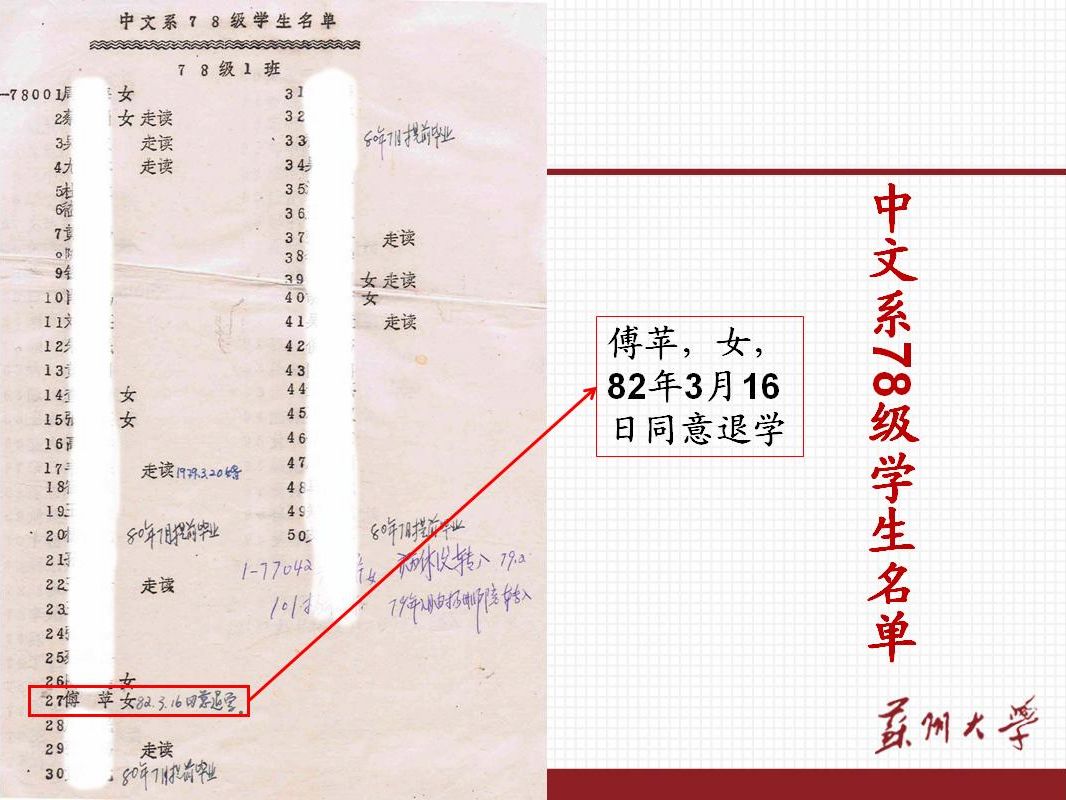
You have sullied the academic integrity of Soochow University by claiming to have taken BA and MA degrees from the institution. As is shown in our well-kept archives, you withdrew from us on March 16th, 1982, with neither diploma nor degree, not as a result of your facing any likelihood of your being “sent to remote China,” but that of your failing to finish required courses. Lies, however repeated, remain lies, no more and no less.
Your so-called research on female infanticide in rural China was simply non-existent---- as evidence goes, never ever did you, while with Soochow University, conduct any research or publish any research finding on such a topic. Regrettably, by claiming that readers “made assumptions” on this matter, you all so conveniently dodged the questioning of whether or not you actually wrote it.
Equally, your alleged experience of secret arrest as punishment for writing a “daring and controversial article” is not anywhere close to truth. Your “accounts” of persecution with, in particular, your depiction of how you got arrested and released, simply cannot pass facts’ scan for entry into truth.
That, according to your “narrative,” Soochow University conducted intrusive physical checks on all female students’ periods, is a pure fabrication out of nothing. We have never heard of, let alone administering, these malpractices. This very story inflicts an insult not just upon yourself, but upon your fellow students and your alma mater, leaving the name of Soochow University being gravely defiled across the world.
Whatever value you may have felt it free to assign to your memoir, its story of your learning life in Soochow University is proven unauthentic and short of validity, with a good part of it being outright falsehood. We agree with you that “democracy means everyone is entitled to freedom of expression;” but we would like to remind you that freedom of speech stands as a human right to uncover truth, not as a right to justify lies and liars. We agree with you that humanity has every need to reach out for forces that “unite” us, instead of for those that “divide” us; but we would like to remind you that “civilized contributions” to humanity requires, among others, every one to be a proponent of truth rather than a proponent of falsehood.
We, Soochow University, have duly noticed your expressed wish to seek for a peaceful reconciliation with us. The words, however, have not been met with any substantive deeds. To actualize the wish, Ms Ping Fu, you are bound with an inalienable obligation to deliver a formal and open apology to Soochow University, your fellow students and teachers whom your memoir has caused to suffer, and exercise an immediate stop to any promotional activity for the memoir, either asking your publisher to recall the first edition of your memoir, or thoroughly correcting the falsehoods thereof to set to print, in the coming November, a truly authentic and valid story to readers and yourself, failure of which is sure to make us take legal actions.
致傅苹女士的公开信
傅苹女士:
你的回忆录《弯而不折,一段生命两个世界》所述你在苏州大学求学的经历严重失实,我校特致此一公开信函,以正视听。
在已经发表的两个声明中,我校严正指出,你在回忆录中所虚构的事实,以及你在媒体上罔顾事实的解释,严重地损害了我校的声誉并对你的同学和老师造成了极大的创伤。迄今为止,你迟迟未能就此公开道歉,一再排拒事实、回避真相,并在随后的采访及在ALA的演讲中继续为自己的谎言狡辩。
你声称,你在苏州大学获得了本科和硕士学位,此言损及我校学术声誉,意在何为?学校档案显示,你于1982年3月16日办理退学手续,未能获毕业证书和学位证书。退学的原因远非因为你担心被“派遣至边远地区工作”,而是因为你本人违反了学校学籍管理规定,无法毕业。要知道,谎言,哪怕是重复千遍万遍,依旧是谎言。
你声称,你曾在苏州大学求学阶段从事了以中国农村地区杀害女婴为主题的研究。这纯属子虚乌有。据我校查证,在校期间,你从未从事过这一专题的研究,也从未以论文或文章形式发表过这样的研究成果。如此空穴来风实为主观臆想。面对读者的质疑,你不仅躲闪其辞,还指责读者“无端揣测”。
你还声称,在校期间,你曾因某一文章的发表而被秘密逮捕。这也是无稽之谈。你对于所谓的你遭受迫害的“描述”,特别是你对于逮捕与释放的“叙事”,是完全没有事实根据的凭空捏造。
你对于在校期间曾遭受强制性指检之害的“记事”,同样是无中生有的虚妄之词。如此侮辱人格之举,为我校闻所未闻,又何谈实施?这不仅是对你自己的侮辱,也是对你的同学和苏州大学的侮辱。这严重损害了苏州大学在国内外的声誉。
你尽可以在主观上给你的回忆录贴上任何标签,但铁的事实告诉人们,你的有关就读于苏州大学的故事严重失实,不少是完全的谎话。的确,“民主之意在于人人得言语之自由”;但是,我们不能忘记,言论自由,其目的在于发掘真相,追求真理,而不是用谎言来欺世,欺世以盗名。的确,人类理应拥抱那些能够将彼此“团结起来”的力量,而不是那些令彼此走向“分裂”的力量;而要在此基础上对人类作出“文明的贡献”,人就必须成为真理的捍卫者,而不是谎言的捏造者。
傅苹女士,苏州大学已经注意到了你想与苏州大学达成和解的愿望, 但迟迟未见到有任何实质的行动。要使这一愿望得到实现,你必须向苏州大学、向因你的回忆录而受到伤害的同学和老师公开正式道歉,立即停止一切与你的回忆录相关的宣传活动,要求你的出版机构撤回第一版回忆录,或者在计划于今年11月出的新版中彻底改正原书中的不实之处,还读者以及你本人一个真实的故事。
如若不然,苏州大学将采取必要的法律手段。
苏州大学
2013年7月21日



Fu's memoir tainted by 'false memories'
By Leng Baoqing
Chinese communities around the world have poured criticism on the memoir "Bend, not Break" by Ping Fu, a prominent Chinese-American businesswoman, with many claiming that it contains factual inaccuracies and distortions of the truth.
Suzhou University, Fu's Alma Mater (then called the Jiangsu Teacher's College), recently posted an announcement on its official website which detailed specific instances in which it believes Fu distorted the truth in her book. An incident which came in for particular criticism was Fu's account of female students being examined for evidence of bleeding during their monthly menstrual cycle. In 2010, Fu, serving on the board of the White House's National Advisory Council on Innovation and Entrepreneurship, told US media outlet NPR that she witnessed the brutal execution of a teacher by Red Guards in which the teacher was pulled apart by four horses. Fu later admitted that this event might not have taken place and that her "emotional memory" might not be accurate.
For many, however, Fu's explanations are simply excuses. There is no doubt that the memory can play tricks at times; however it seems inconceivable that anyone's memory could be so confused that they are unable to recall whether at a particular time they were in jail or graduating from university.
Experts, however, say that such instances of false memory are quite common. Martin Conway, a professor of cognitive psychology at Leeds University, and Elizabeth Loftus, a distinguished professor at the University of California, Irvine, have both proved in their research that even memories which a person believes are true and accurate can be false. Memory is based on subjective cognition and presupposition and does not work like a tape recorder. In addition, people's memories are constantly changing, and they also tend to have an idealized picture of themselves in their memories.
In Fu's case, this manifests in her attempts to present herself as the personification of the American Dream. Fu's difficult past and rise to prominence is proof enough of her success. To some extent, the urge to idealize or exaggerate memories is understandable. But Fu has gone too far in her memoir and this is what has upset her fellow Chinese-Americans.
Suzhou University's criticisms and presentation of the facts on its website were fair, but Fu's book should not be taken too seriously, as its distortions are simply the author's latest attempt to adapt to mainstream U.S. society and pursue greater success.
Surprisingly, an article in the New York Times on June 28 titled "Cultural Revolution Vigilantes" went to great lengths to defend Fu. The article, which was written by Joe Nocera, argued that "Ping Fu's book has mistakes in it. But it is hard to see how they justify the level of extreme, unrelenting vilification she has suffered."
His point is debatable. In a pluralistic society, it is normal for public figures to face severe criticism. Fu has every right to revisit the Cultural Revolution, but she also has an obligation to tell the truth in her publications.
For example, Fu says in her memoir that, when she was a college student, she was sent to jail for writing about female infanticide in Chinese villages (All the current evidence proves that her account was a complete fabrication). Abortion is the subject of intense public and political debate and discussion in the U.S. In 1973, Harry Blackmun, Associate Justice of the Supreme Court of the U.S., authored the Court's opinion in Roe v. Wade, invalidating a Texas statute making it a felony to administer an abortion in most circumstances. The case caused an immediate uproar and made Blackmun a target for opponents of abortion who sent him hate mail and death threats as a result of the case. Mr. Nocera, what do you have to say about this behavior?
The majority of Fu's critics are not opposed to a rethinking of the Cultural Revolution and welcome reasoned debate. However, such debate should be grounded in fact, as this is the only way to achieve mutual understanding.
As a Chinese person who has studied abroad and fully understands the difficulties faced by overseas Chinese, I hope all of them, Fu included, can achieve their life dream and be successful. However, different from Mr. Nocera, I believe that those who revisit the past and offer a different perspective on events (including the Cultural Revolution), should have a sense of responsibility. In order to fully and successfully integrate into American society as an American citizen, Ping Fu must base her writing on verified facts instead of unreliable memories.
The author is a current affairs commentator.
This article was first published in Chinese and translated by Li Huiru.
Opinion articles reflect the views of their authors, not necessarily those of China.org.cn.

Qiaobao: Suzhou University accused you for falsifying academic credentials. They displayed your student registration and files at the school and proved that you had dropped out in March, 1982 and did not earn any degree there. Have you ever publicly stated that you have a Bachelor degree in Chinese Language and Literature from Suzhou University?
Fu Ping: I rarely mentioned Suzhou University because I didn't obtain any degree there. In my social media platforms, such as LinkedIn, Facebook, Twitter, etc., I never included Suzhou University. In fact, in all places I have control, I never mention Suzhou University.
But there are places that I have no control of. About 10 years ago, our company's marketing department has a girl from Malaysia. I told her that I did not graduate from Suzhou University. So she wrote on our page "post graduate degree." Because she thought "post graduate degree" could also mean "non degree" besides "masters graduate student." We made corrections right away and it was not on our company web site. But recently when our company changed web site, an program that was automatically fetching files made it visible again. I did not discover it in time.
Right now there are many web sites, including Bloomberg, Wall Street Journal, etc., all carried this incorrect information. I found out later that it was because their automated search feature. The real culprit of this academic credentials fraud is the automated search, not me.
In fact, my business is in computers. I earned BS and MS in computer science in the US. I do not need a degree from Suzhou University for any of my work. It's not like a degree from Harvard, after all.
Someone said that they obtained information from University of Illinois where I had worked to prove that I had claimed of possessing a degree from Suzhou University. But the information I do possess do not prove that. I have also inquired to University of Illinois. They told me that they have never told anyone that I had a degree from Suzhou University. I feel that those who are attacking me were misled. [Note: we do have evidence indicating otherwise.]
Another place is a technological paper I wrote as the third author. The author's bio section of this paper stated that I earned a Bachelor of Chinese Language and Literature in 1983. As a matter of fact, I did not write that. I only published a technological paper. The author's bio was added by editors.
Qiaobao: In your book, you said that in the fall of 1982, you "innocently walked across campus making preparations for graduation, someone sneaked up behind me, jammed a black canvas bag over my head ... escorted into a nearby car." Since you had already dropped out school that March, why were you walking on campus in the fall?
Fu: This is a typo. If you read the whole passage, all the stories happened in the spring. The fall only occurred in this sentence. It was an error.
In fact, I have corrected it as soon as I found this mistake.
Qiaobao: You also mentioned in your memoir that you published a paper while you were in school, on the subject of female infanticide under the one-child policy. You were arrested and deported because of it. But Suzhou University said that all the graduation thesis in the Department of Chinese Literature were about literature or linguistics. They wouldn't be involved in sociology subjects such as infanticide. There were no teacher for this thesis of yours. How do you respond?
Fu: Before graduation, I wanted to go to graduate school in journalism at Nanjing University. So I intended my thesis to be like a news report. In 1981, the one-child policy was going crazy in China and got my interest. With the permission from my adviser, I started interviewing people and then discovered the female infanticide problem in rural China.
I heard a lot of stories from rural women and became their sounding board. In order to do this work, I had indeed spent a lot of time and missed a lot of classes.
Then I wrote them down and showed my teacher. My teacher passed my article to his friend in Shanghai's Wenhui Daily. At that time I did not know where this paper reached, but heard later that it was handed higher and higher in the official hierarchy and reached the Party Central.
This was not good news for the new leadership. Therefore I was arrested and locked up for 3 days. After the release, the police told me to leave Suzhou University and not tell anyone the reason. That's why my mother and I were insistent in dropping out of the school.
Qiaobao: Who is the teacher who allowed you to write this article?
Fu: It's not just one, but I cannot provide names. In fact, the person who approved my work no longer admits that. I don't think it's necessary to expose this. They are all my teachers and classmates. If they want to say I am lying, then let them say that. I know who I am and don't want to explain.
Qiaobao: In your book you said that you experienced "finger checking" for pregnancy. This was strongly condemned by Suzhou University and your classmates. What happened there?
Fu: This is indeed my mistake. I wrote about "finger checking" to illustrate the difference between China's one-child policy and the population policy in the west. In 1981, getting pregnant in China could be illegal. Therefore there was checking with fingers. But the procedure was using one's own fingers to prove period, not allowing other people's fingers to enter.
I told my coauthor Meimei Fox of this concept. But she did not write accurately. The illegal pregnancy checking was subjecting to those who have already given birth, not all females. It was written in the book as for all women, but not students of Suzhou University.
But Chinese are not a precise language. It could be interpreted in different ways when viewed from different angles. It read like all female students in Suzhou University must submit to the checking. I discovered it later and corrected it on New York Times.
I feel sorry for this. I did not spot this mistake before the book went to press. Later Fang Zhouzi hyped on it and wrote it in a very dirty way. If this hurt the dignity of students in Suzhou University, I am willing to apologize.
But the "finger checking" absolutely happened. It was not just me. Other articles have mentioned it too. I wrote it because I hope to raise the outside world's awareness of China's one-child policy. It was not meant to insult female students in Suzhou University.
Qiaobao: You had participated in a literature organization called Red Maple Society. You said in the book that you were arrested and interrogated because an article published by the society. Suzhou University said that was a lie. What do you think?
Fu: I had indeed not been taken into custody because of Red Maple Society. But in my book I used the word "arrest," which could mean "taking into custody" or "detain," it could also be understood as "stop." It was not as going into prison, but that they don't allow you to attend classes. They put several of you into a room, make you write confessions and expose each other.
The Department of Chinese Literature had a student journal called Wu Gou. According to my memory, I was the editor-in-chief (主编) for Wu Gou, but not the ultimate decision maker (总编). Because I was the only girl in the society and the journal, they let me be the editor-in-chief, in charge of printing and logistics. Now some people say I wasn't the editor-in-chief. If they could tell me who was, I would like to correct that.
In January, 1979, Wu Gou published the article "The Confession of a Communist Party Member" by Liu Buchun. The article raised doubts on Communist Party and Communism.
At that same time, Peking University, Tsinghua University and other 11 colleges co-founded the magazine This Generation. They reprinted an article from Wu Gou. Our journal sent a representative to Beijing to attend a meeting by This Generation. I don't remember who went, but it wasn't me.
After arriving at Beijing, he didn't attend the meeting but went to the Great Hall of People to watch Deng Xiaoping receiving leaders of the Communist Youth League. There, Deng Xiaoping clearly stated that he wouldn't allow universities publish their underground journals. Afterwords, This Generation and Wu Gou all closed down. The school investigated and interrogated us. The Red Maple Society could not meet any more.
-----Original Message-----
From: Kelley, Mary Beth A
Sent: Monday, February 04, 2013 1:48 PM
To: Ashman, Keely K
Subject: RE: Inquiry about Ms. Ping Fu's MS degree
Hi Keely
We had a student by that name graduate with an MS from UIUC May 1990 and her Advisor was Jane Liu. She also obtained a BA in Computer Science & Economics from the University of CA, San Diego in 1988 and a BA in Literature from Shuzou University-China in 1982. Her original application file indicated she attended the University of New Mexico from 1984 to 1986, but no degree was awarded. It appears her wiki page is missing some information.
Mary Beth
-----Original Message-----
From: Ashman, Keely K
Sent: Monday, February 04, 2013 1:25 PM
To: Kelley, Mary Beth A
Subject: FW: Inquiry about Ms. Ping Fu's MS degree
Mary Beth,
Hi! How are you? I need to come over for a visit sometime soon so we can catch up!
Weird question, who would be able to find out if the student below graduated in 1988 with CS degree? Thanks!
Keely K Ashman
Recruiting Assistant
Engineering Career Services
3275 Digital Computer Lab
1304 W. Springfield Ave.
Urbana, Il 61801
217-333-6454
kashman@illinois.edu
'Heartbroken' author Ping Fu willing to apologise for inaccuracies in memoir
Trying to head off a lawsuit, Chinese American tells the Post she was willing to apologise for what her former university schoolmates and officials call 'falsehoods' in her book
Wu Nan
In many ways, Ping Fu embodies the American dream. The 55-year-old Chinese American entrepreneur and author is an important figure in the global 3-D printing industry, and she sits on US President Barack Obama’s National Advisory Council on Innovation and Entrepreneurship.
But six months after she published a critically acclaimed memoir Bend, Not Break: A Life in Two Worlds, Fu, chief strategy officer of 3D Systems in the US, faces potential international lawsuits. Her alma mater, Soochow University in Suzhou, and some of her former schoolmates are threatening to take her to court for libel in China and the US.
“Her book humiliated the image of China in the world and the reputation of Soochow University as a public education institution,” Chen Jinhua, director of the university’s news centre, told the South China Morning Post. University officials have joined hands with a group of former students, classmates of Fu’s from more than 30 years ago, to demand that she apologise for what they call “falsehoods” in her book, and stop all promotional activities related to it.
“No society at any time should applaud success built upon lies,” Liu Biao, an official at the university’s president’s office, told a meeting of alumni at Soochow two weeks ago. “We will take further actions.”
This is not the book's first controversy. Fu devoted chapters to her early life as the child of a persecuted intellectual family, growing up during the tumultuous Cultural Revolution period, between 1966 and 1976. She recounted heart-wrenching stories of being separated for years from her parents from the age of 10, and of being forced into child labour, starved, tortured, even gang-raped.
Some of these claims, along with those she made in previous Western media interviews, were bitterly contested in China in the past months. Hundreds of angry comments and negative ratings were left on the Amazon.com page for her book, most by Chinese readers. Protest e-mails were sent to her publisher, her company and her associates.
Tens of millions of Chinese were persecuted during the disastrous decade of chaos and violence, started by Mao Zedong in 1966 and ending soon after his death in 1976. The estimated death toll ranges from one million to 20 million. However, Fu's critics accused her of making up many of her sad personal stories to win sympathy and sell her book. Some, such as the controversial Chinese academic fraud-buster Fang Zhouzi, wrote detailed essays to prove that the abuses and atrocities she claimed couldn't possibly have happened.
In 2010, Fu told US media NPR that she witnessed Red Guards execute a teacher by having her quartered by four horses, simply to frighten the children into submission. After Fang raised sharp questions about the veracity of this story, Fu admitted that this that traumatic event might not have taken place, and that her “emotional memory” might not be accurate. NPR has since removed the interview from its website.
College years disputed
Now, months after the previous storm of controversy seemingly cooled down, renewed criticism and legal threats from China are once more putting the high-flying executive on the defensive. The disputes have moved from her childhood history to her college years, starting in 1978, two years after the Cultural Revolution ended.
Former classmates and teachers are not only challenging Fu’s self-claimed academic credentials, but also casting doubt over some of the most riveting events in her book. These often dealt with issues that remain sensitive in Sino-US relations to this day, including birth control, torture, freedom of the press and persecution by order of top Communist Party officials.
Fu said she was willing to apologise for some of the inaccuracies in her book, which she blamed on memory failures or editing errors. She also said she would like to reconcile with the university to avoid a lawsuit.
One anecdote in Fu's book seems to anger her critics in particular – that university officials used to check female students’ periods with their fingers to make sure they were complying with mandatory government rules on birth control.
“I would like to issue an open apology for the description that appears about [Soochow University] conducting intrusive physical checks on all female students' periods for birth control purpose,” she said. Fu told the New York Times in February that the account was an error she had tried on several occasions to correct before publication. Instead of submitting to intrusive checks by officials, female students had to use their own fingers and show blood during their periods, Fu said.
As the leader of a student group called the Red Maple Society, according to the book, Fu had incurred the wrath of then-leader Deng Xiaoping after publishing a “daring and controversial article” criticising the Communist Party for corruption. According to her accounts, Deng, restored to power only a few years earlier, was visibly displeased after he read the article during a meeting with representatives from student publications.
“University officials arrested and interrogated all the students who belonged to the magazine group,” she wrote. “As the editor in chief, I was held most responsible for the trouble. For punishment, I was given a black mark in my personal file.”
But that was not the end of her political troubles. Fu also wrote that she was briefly kidnapped by unknown thugs and then banished from the university for doing research and writing a paper on infanticide in rural China, a barbaric side-effect of the one-child policy and people's preference for boys.
Fu also wrote she was forced to leave school without graduating, and officials had told her to leave the country. She went to the US in 1984, studied at the University of New Mexico in Albuquerque, and later transferred to the University of California in San Diego to study computer science.
'It's just we remember differently'
However, Soochow University officials have shown journalists dozens of documents including Fu's full academic records, to prove that she never conducted research or wrote a thesis on female infanticide, nor was she ever punished or arrested for political essays in student publications.
“The so-called arrest and interrogation never happened. I am angry at her for lying about this,” said Ni Junqiang, Fu’s class adviser from 30 years ago. Now 63, Ni manages his own high-tech company in Suzhou. He said Fu frequently missed classes during her college years and on several occasions he recommended that the university give her demerits.
Speaking to a Post reporter by telephone in late June, Fu conceded last week that some of the details in her book were not accurate. “There was no arrest or time in jail or prison for the Red Maple Society members. We did informing and confession.”
She also added: “I wrote a memoir and this was my memory of what happened [30 years ago] and how I felt. If someone said they remember differently I’m not going to say they are wrong. It’s just we remember differently.”
But the university’s investigation has nonetheless stirred up painful memories and ripped open old wounds. Liu Buchun, Fu's former schoolmate, said Fu stole his story about suffering political persecution for criticising the Communist Party. Liu said that he was the one who delivered a speech at a meeting of student party members in 1979, airing doubts over the party’s teachings.
Liu, now a retired high school teacher, said he and several editors of a student magazine who published the speech suffered years of retribution in the form of demotions and lost opportunities. The consequences haunted their entire adult lives, Liu said. But Fu was not involved in either the writing or publication of the speech, nor was she punished for it, he told the Post.
“Correcting the wrongs of the Cultural Revolution is necessary, but not by making up stories like Fu did,” Liu said. “Lies have no redemptive power. Self-glorifying lies are even more despicable.”
'Heartbroken and deeply saddened'
In the face of harsh criticism from China, Fu said in February that she was “shocked, heartbroken and deeply saddened by the smear campaign”. However, she has on different occasions retracted some of the statements she made to Western media.
“When people are upset, you are touching on something sensitive. If people need to talk about the Cultural Revolution and by criticising me they can create some healthy discussion, that’s my contribution,” she said last week.
But she admitted: “It also bothers me. Sometimes I'm confused. I'm not helping the ‘American side’ or ‘Chinese side’ to attack one other.
“We should unite rather than divide; extreme opinion divides. I won’t fight with Soochow University. It will only hurt both of us.”
Now a mother of an adult daughter and working for a South Carolina-based firm specialising in 3-D printing technology, Fu said she wished the debate over her memoir would calm down so she could focus on her responsibilities at home and at the company.
“Creativity for us is about thinking out of the box exponentially, and innovation is imagination applied,” she said. “My new role is a perfect combination of creative destruction and pragmatic problem-solving, I love what I do: 3-D printing.”
Chinese college threatens libel suit against US author Ping Fu
Wu Nan in Beijing
Chinese-American author Ping Fu may soon be hit by international lawsuits for her controversial memoir Bend, Not Break: A Life in Two Worlds, which has been debunked by Chinese academics and critics.
Fu’s alma mater, Soochow University in Suzhou, Jiangsu Province, said on Friday that anecdotes in her memoirs, in which she makes claims that during her time at the university she was arrested for her college research, were “falsehoods” and called on the author to participate in a public debate to clarify the details.
The university said that if Fu failed to respond and apologise, it would file libel lawsuits both in China and the United States against her.
“These falsehoods have given both our school and country a poor reputation and caused our alumni and friends to feel deeply incensed,” Soochow University said in a statement.
The university said earlier this week it had formed an investigation team to examine the controversial book, published in February, after it had received several inquiries from university alumnis and media on the memoir. A staff member of Soochow University told the South China Morning Post that the investigation had gone on for about three months and they would hold a press conference next week to announce the results, with Fu’s then teachers on hand to answer questions from the public.
The Post first reported in February the doubts raised by academics and readers buying Fu’s book, who questioned the dramatic details in her memoir including what she called the “twisted cultural revolution experience” of studying at Soochow University. One of her controversial anecdotes claimed school officials conducted intrusive physical checks on female students’ periods, supposedly for birth control purposes.
Other shocking claims in Fu's book include that she was sent to a labour camp at age 8 or 9 with her younger sister during the Cultural Revolution, tortured, gang-raped, and forced into child labour.
In a 2010 interview with NPR, Fu said that she had, during the Cultural Revolution, witnessed Red Guards execute a teacher by tying each her limbs to horses and having them tear the teacher into pieces, done specifically to frighten the kids into submission.
Heated debate ensued when China’s well-known academic “liar hunter”, Fang Zhouzi, publicly challenged the accuracy and consistency of Fu’s memoirs, after the computer scientist and author conducted interviews with US media in which she occasionally changed details of her claims. Hundreds of Chinese netizens supported Fang’s campaign against the memoir, many of them leaving angry messages on the Amazon page for her book.
Although she said that she was “shocked, heartbroken and deeply saddened by the smear campaign”, Fu later retracted some of the statements she had made to the media.
Fu, 55, also responded to critics that her book was an autobiography and that her memories could be wrong. She was backed by her publisher Portfolio, Penguin’s business book imprint.
Fu, a successful entrepreneur who has served on the US National Advisory Council for Innovation and Entrepreneurship, published her memoir during the time she was appointed Chief Strategy Officer of 3D Systems earlier this year.
She declared that her story was of a life straddling two worlds in China and America, which she billed as “one person’s journey from nobody to somebody”.
“It reflects how my past experiences influenced who I am today and how I make decisions as an entrepreneur,” she wrote.
However her alma mater college Soochow University investigated the memoir by reviewing student records in their archives and interviewing her Fu’s teachers and classmates. They claim this investigation has confirmed facts that contradict details in the book – including records of her attendance at the university without earning a degree, records that she studied English as part of the curriculum, and that there was no enforcement of birth control measures on undergraduate students.
“This university ultimately concludes that Ping Fu’s relevant narrative in her memoir is factually inaccurate and has damaged the image of Soochow University,” said Soochow University. “(We) reserve the right to take further action.”
Soochow University's Press Briefing on Deceptive Behavior of Ping Fu
Ladies and Gentlemen,
In the last 3 months, many of our alumni and friends at home and abroad have contacted us regarding the validity of an English language memoir, Bend, Not Break: A Life in Two Worlds, written by Ping Fu, a former student enrolled in our Department of Chinese Literature in 1978, and published on December 31, 2012. We were informed that this memoir contains descriptions that contradicted with actual facts at the time. It insults the reputation of Soochow University as well as the image of our country and caused deep disappointments and anger among our alumni and friends.
Upon the notifications and information received by us, Soochow University organized an investigation team to carefully examine Ping Fu's student file in our archive, to interview Ping Fu's former teachers and classmates, to collect original copies of the book, proof of her falsifying academic credentials, and other evidences of her real experience while in our school. We have previously published two official statements, both in Chinese and English, on the homepage of our school's web site.
We thank all the friends from the media who travel here and your attention to this important matter concerning the reputation and image of our school and country. Now, let me explain several points regarding Ping Fu's memoir in which she presented false experience while in our school and related issues.
1. About Ping Fu's academic experience in Soochow University
Ping Fu, female, born in 1958, a native from Nanjing, was admitted as a student in Chinese Literature in September 1978 into Jiangsu Teachers' College (predecessor of Soochow University). During her undergraduate years, a demerit entry was made in her record in October 1981 for several infractions and repeated unexcused absences. In those years, all students enjoyed free tuition, living experience, and guaranteed jobs upon graduation provided by the national government. They were therefore expected to follow certain standards and discipline in school. On March 16, 1982, upon strong request froms her and her mother, Ping Fu formally withdrew from school. She left without BA diploma or bachelor degree from Soochow University, let alone an MA degree. However, Ping Fu claimed that she had BA and MA degrees from the Soochow University, and Ph.D degree from Nanjing University on several occasions. We have inquired Nanjing University which confirmed that Ping Fu was not in their PhD grantee list.
Ping Fu wrote in her book that she entered Soochow University when she was 19 years old. Yet, according to her registration form filled by herself, she was born on May 30th, 1958, which indicates that she should be 20 years old when she registered at Soochow University in October, 1978.
Ping Fu entered the Department of Chinese Literature in October, 1978. At that time, the national college entrance exams are conducted separately for liberal arts and science students. The liberal arts students took exams in Chinese, Math, Politics, History, Geography, and Foreign Language. The science students took those in Chinese, Math, Politics, Physics, Chemistry, and Foreign Language. Scores for Foreign Language were not included in the admission criteria however. Our records show that Ping Fu was admitted into the Chinese Literature major per her first choice. There was no evidence that she had wanted to study Space Engineering but got assigned for Chinese Literature.
2. About her English classes from 1978 to 1982
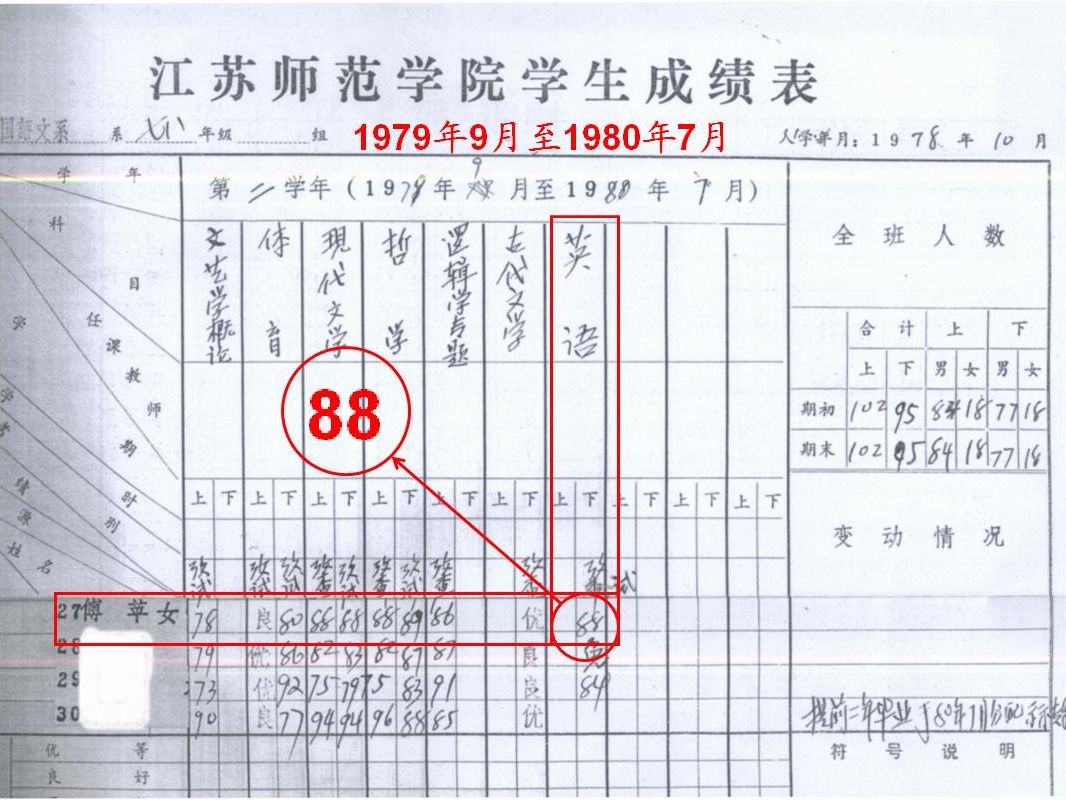
In her memoir, Ping Fu claimed that she went to the U.S., knowing only three English words - "hello, thank you, and help." Our records show that she earned an "Excellence" grade and an 88 (of 100) in English as a freshman (1978 to 1979) and as a sophomore (1979 to 1980), respectively. In both cases her scores were above average of her class. English was a mandatory course for all our students.
3. About Ping Fu's Graduation Thesis
Ping Fu withdrew from this University in March, 1982, so her name is not in the list of graduates of that year. There is no graduation thesis in her file. On the departure check list which was signed by each graduate, there is no record indicating that she received any graduation or degree certificate.
As an additional note of clarification, student thesis topics in the Department of Chinese Literature have always focused on literature and linguistic topics and would not involve social subjects such as female infanticide. Besides, topics and contents of graduation thesis required pre-approval by advisory teachers. We have found no teacher aware of Ping Fu having written a thesis on that subject.
In her book Ms. Ping Fu wrote that she was arrested and interrogated by university officials because she had participated in a "Red Maple Society," been the chief editor of its magazine, and published her own articles. There was indeed a Red Maple Society, but there was no one among the class 78 students who was arrested or persecuted for being a member of that organization. In fact, the University had no power to arrest or interrogate students. We have two professors who were key members of Red Maple Society back then. They have been working in this University until today. If they were persecuted, how could we keep them as teachers after graduation and later became professors?
Ping Fu also wrote about a representative from Red Maple Society was received by Deng Xiaoping during a private meeting. This is completely untrue. Had that actually happened, the University would have recorded and hailed it as a great honor.
4. Finger Checking for pregnancy
According to many faculties of SooChow University, including former classmates, mentors, officials in the department of Chines literature of Ping Fu's, and many students from her class, the school had never applied the insulting method of checking female students' period with fingers. Some of the female students from that time who are working in our school now can testify to that.
5. About the kidnapping in fall of 1982 on S.U campus, in a black head cover.
Ping Fu mentioned in her book that, "One day in the fall of 1982, as I innocently walked across campus making preparations for graduation, someone sneaked up behind me, jammed a black canvas bag over my head..." As a matter of fact, Ping Fu had dropped out in March of 1982. So, how could she walk on campus to prepare her thesis in that fall? Even all her former classmates had already graduated and left school by then.
6. About Ping Fu made up life story in Cultural Revolution in her book
From the registration record in Ping Fu's own handwriting, we know that she had completed formal middle level education. She graduated from Nanjing Guanghuamen High School in 1976. She was the class president. In 1973, she joined the Chinese Communist Youth League. After her high school graduation in July, 1976, she worked for a year in Nanjing Radio Equipment Factory for a monthly salary of 17 Yuan. In 1978, the acceptance rate for college admission was very low. It's hard to imagine one could be admitted without decent grades in high school. This proves that many of her description in Bend, Not Break during that period were made up.
In summary, It is very clear that Ping Fu lied about her life relevant to Soochow University in her book. We have several of her former teachers and classmates here. They will answer your questions and tell you the actual facts. We will not comment or answer any questions on events unrelated to our school as we have not investigated them.
Although Ping Fu never graduated from Soochow University, she was nonetheless one of our students and alumni. So, for the sake of love and care, and for the reputation of our university, the best way to resolve this issue is to show the historical truth. This will also benefit Ping Fu herself in the long run. We once again call on Ping Fu to thoroughly acknowledge and rectify her lies, remove falsified content from her book, stop media interviews and speeches promoting her book, apologize to the people and institutions, including Soochow university, that she had hurt. At the same time, we call on publishers and media to take historical facts seriously and maintain professionalism, ethics, and integrity. We also appeal to our media friends, who came here today from home and abroad, to objectively report Ping Fu and her relevant issues based on fact and truth.
I will make the manuscript of this speech available to any reporters after the meeting. Please note, however, that PDF files containing evidences are not to be disclosed at this time.
Thank you.
苏州大学关于中文系78级学生傅苹造假事件的有关情况说明
2013年6月20日上午
各位记者朋友:
近期,关心我校发展的海内外校友们和朋友们,以来函来电方式,反映或提及了我校中文系78级学生傅苹撰写的,2012年12月31日正式出版的回忆录《弯而不折:一段生命两个世界》(Bend, Not Break: A Life in Two Worlds)中,有多处与当时事实完全不相符合的文字表述,有辱于国家形象和苏州大学的办学名誉,引起了海内外校友和朋友们的极大不满和愤慨。
收到来函来电后,我校立即成立了由相关部门、学院和老师组成的调查小组,积极发动和汇聚各界社会力量,集中走访傅苹在校学校期间的老师和同班同学;认真核查傅苹在校读书期间的学籍档案;仔细收集由校友和各界朋友向我们提供的相关证据,包括傅苹的英文原版书、傅苹的学位造假证明、傅苹在校学习和工作时的人证物证等具有法律依据的材料;在我校校园网首页发布了两份中英文的学校官方声明。
感谢各位媒体朋友远道而来,关心这一件涉及国家形象和学校办学声誉的重大事件。现在我就傅苹《回忆录》中关于在“我校经历”的一些不实表述及其他相关情况,向各位媒体朋友进行说明。
一.关于傅苹在我校的学习经历
傅苹,女,1958年生,南京籍高考生,于1978年9月进入江苏师范学院(苏州大学前身),专业是中国语言文学。在读期间,多次无故旷课,违反学校学籍管理规定,影响恶劣,学校曾于1981年10月给予其行政记过处分。当时入学的大学生,均是国家包其生活费用,包分配工作,不交学费,因此在学习纪律方面有相应要求。后来因某种原因,应傅苹本人和她母亲的强烈要求,于1982年3月16日办理退学手续,未获毕业证书和学位证书,更不用说硕士学位了。但是目前她自己在多处地方均介绍自己是苏州大学学士、硕士和南京大学博士,经向南京大学查证,南京大学博士毕业生中没有傅苹的名字。
傅苹在书中提到她入学的年龄为19岁,但我们根据她亲笔书写的学籍登记卡上的记录,她是1958年5月30日出生,1978年10月入学,所以应该是20岁入学。
傅苹于1978年10月到江苏师范学院中文系读本科,当时的高考选择专业是按文理两科不同考试录取,文科和理科各考6门,分别是语文、数学、政治、历史、地理和外语;语文、数学、政治、物理、化学和外语;外语成绩不列入录取总分。记录表明她自己填写第一志愿并被顺利录取,不存在她《回忆录》中所说,想学航天工程专业而被指定学习中国文学之事。
二.关于傅苹于1978—1982年四年本科期间修学英语的问题
傅苹在书中提到,“她去美国之前只认识三个英文单词”。我们核查当年的学生成绩记录后的事实是:1978年10月—1979年7月,其英语成绩为“优”,1979年9月—1980年7月,其英语成绩为“88”分,两次考试成绩在班内均属中上等水平。英语是学生的必修课。
三. 关于傅苹毕业论文的问题
傅苹于1982年3月从江苏师范学院退学,所以在毕业生名单中未见其名字,在档案中也未见其毕业论文,在毕业生签署的离校记录上,也没有她获得毕业证书和学位证书的记录。
此外,江苏师范学院中文系毕业论文都是以文学和语言学为研究对象,而不会涉及“杀害女婴”这一涉及社会学的内容,且毕业论文的题目和内容是需要指导老师同意的,没有老师知道她写过这一论文。
傅苹在书中提及,在其就读期间,因参加“红枫社”并担任社团杂志主编,因发表文章而被学校官员逮捕和审讯。红枫社确有其事,但78级同学中没有任何人因红枫社受到逮捕或迫害,学校也没有逮捕学生和审讯学生的权力。今天还有两位当年的红枫社主要成员仍在苏州大学做教授,如果迫害他们,当年怎么可能让他们留校做教师并当上教授博导?
另外她还写了红枫社成员受到邓小平接见的事,这完全不是事实。试想如果真有这样的事,当年的江苏师范学院肯定会有记录和进行大力宣传。
四. 关于“手指检验”是否怀孕的问题
根据苏州大学多位教师(这些教师包括她的同班同学、班主任、中文系领导)和当年78级的同学证实,学校从未用这种侮辱性的手段对女生进行相关检验。关于这个问题,现在仍在学校工作的当年78级的女生可以证明。
五.关于傅苹1982年秋天在校园里被戴上黑色布套强行带走的问题
傅苹在书中提到,1982年秋天,她“走在校园里,为毕业做着准备,忽然有人从背后悄悄靠近我,用黑色的布袋套住我的头……并把我押上附近的一辆车”。事实上是,傅苹于1982年3月就退学了,所以怎么可能于1982年秋天还在校园里准备毕业论文呢。即便是她的同年级同学,1982年的秋天也都早就毕业离校去工作了(当年是包分配工作的)。
六.关于傅苹称自己在文革十年中的经历问题
我们从傅苹自己填写的学籍卡可以看到,她接受过完整的中学教育,在1976年毕业于南京光华门中学,且中学期间担任班长,1973年加入共青团,1976年7月高中毕业后于1977年在南京无线电专用设备厂当过一年工人,月工资17元。1978年的高考录取率很低,没有比较好的中学学习成绩要考取大学是不可想象的。这证明她《回忆录》所讲的当时情况有许多是编造的。
综上所例,傅苹《回忆录》中涉及苏州大学的说谎内容应该非常清楚了。今天也有傅苹当年的老师、同学在场,他们会接受大家的提问,告诉大家真实的情况。 至于苏州大学以外的内容,我们没有调查研究,不予评论也不便回答提问。
傅苹虽然没有在苏州大学毕业,但毕竟是在学校学习过的校友,从关爱校友的角度出发,从维护学校的声誉出发,还历史的真实面目为最佳解决方案,这也是为傅苹本人的将来着想。我们再次呼吁傅苹能够深刻认识并彻底纠正自己的谎言;撤回《回忆录》中的不实之词,停止宣传《回忆录》的演讲和采访,并向受到伤害的相应人员和机构(包括苏州大学在内)道歉,同时呼吁有关出版社和有关媒体正视历史,坚守媒体的职业伦理和职业素养。我们也恳请今天到场的国内外媒体朋友以事实为依据,客观准确地向世界报道傅苹的有关情况。
会后如果各位媒体朋友需要我这份说明稿,可以提供,但有关证据的PDF文件,请原谅暂时不能提供。
谢谢!
苏州大学关于傅苹造假事件的第二份官方声明
自6月11日苏州大学发布关于傅苹的官方声明后,已经引起了各界的广泛关注,许多媒体和广大校友纷纷来电询问学校下一步如何妥善处理此事,多家媒体强烈要求来学校进行专门采访。其实自傅苹造假风波产生以来,我们一直在试图与傅苹本人联系,希望她正视各方提出的合理的批评意见,用适当方式收回她在回忆录中的谎言,还苏州大学及在其书中伤害过的人们一个清白和公正,这也是苏州大学对曾经在校学习过的校友的爱护之意。可是傅苹本人却置之不理,并在后来的演讲和采访中继续说谎,这已经激起了苏州大学校友和在校师生的共愤,激起了许多有良知的中外人士的共愤。在此情形下,苏州大学不得不采取相应措施,发表了第一份官方声明,以正视听。
第一份官方声明发表后,各界反响非常强烈,现在为回应各界要求,同时也考虑到事态紧急,苏州大学现发表第二份官方声明,内容如下:
1、学校本可在第一份官方声明的同时出具相关证据,因涉及傅萍个人在苏州大学的学习和生活记录,暂时不便公开发布,但可以随时接受媒体和有关人士的采访,并在认为有必要时公开发布相关材料。傅苹当时在苏州大学的辅导员老师和有关师生也可以直接接受采访。我们欢迎中外媒体前来苏州大学采访。
2、诚恳希望傅苹能够勇敢地站出来公开应对苏州大学第一份官方声明所列事实,同时公布她宣称所获苏州大学本科和硕士的相关学历和学位证书,如果不肯应对,且无法提供上述文件,那就必须收回自己所说的谎言。
3、苏州大学愿意在有关中外媒体参加,包括她的出版商和关心此事的各方人士均可参加的场合与傅苹进行直接公开对话,以便澄清真相。 希望傅苹能够响应这样的要求,尽快与我们联系确定对话的时间和地点。联系方式为:
Email:szu-whf@suda.edu.cn Tel:0086-512-6522-0971
4、如果傅苹不能够回应苏州大学的上述要求,苏州大学已经在起草律师函件,律师函将直接寄达傅苹本人,要求她对损害苏州大学名誉的行为进行公开道歉和必要的赔偿。同时苏州大学将在中美两国的报纸和网站上发布致傅苹的公开信,要求傅苹撤回自己的谎言并道歉。如果傅苹拒不理睬上述要求,苏州大学将在中国和美国两国对傅苹提起法律诉讼。
5、美国图书馆协会(ALA)2013年年会将于6月29日邀请傅苹在大会上发表演讲并将向全美国12万家公共图书馆推荐那本充满谎言的自传。虽然ALA是可以自由发言和讨论的场所,但决不是可以让谎言作者自由地让谎言变成真理的地方,即使在美国这也是不能允许的。为免毒害美国青年一代和对全世界产生恶劣影响,苏州大学强烈呼吁ALA取消对傅苹的邀请,不予推荐她的书。如若真的发生上述事件,我校将向ALA发出严重抗议,并立刻公布傅苹造假的全部证据。
特此郑重声明,敬请各方关注!
苏州大学
2013年6月14日
The Second Official Statement regarding Ping Fu’s Deceptive Behavior
Since the release of our First Official Statement dated June 11 regarding Ping Fu’s deceptive statements in her publication about Soochow University, many have expressed interest in, and perhaps concern over, the issue, and some of the media and our alumni have written to enquire about our following moves. A number of individuals from the press have called up for interviews. We must say that, since the incident began, we have been trying to contact Ping Fu (a former undergraduate student who dropped out from our University) to inform her of our hope that she should face up to the criticism from the public, take back her words in her memoir and do justice to all those she has harmed. But Ping Fu has chosen to ignore us while she continues with her deceptive speeches and interviews, much to the indignation of the University’s faculty and students and all related parties at home and abroad. In these circumstances, Soochow University saw it as necessary to clarify our position on the issue.
The First Official Statement has understandably drawn a lot of public attention worldwide. And to update all parties on our stand on the incident, Soochow University now follows up with its Second Official Statement.
1.The University could have publicized related evidences in its First Official Statement, but given the fact that many of these evidences involve Ping Fu’s private study and life records at this University, we did not think it was yet time. However, we are willing to show them to the media and/or to other related parties and to make public the evidences when necessary. Ping Fu’s former advisor and fellow classmates at Soochow University are prepared to accept interviews with media both at home and abroad.
2. Ping Fu should stand up and respond publicly to the facts. She must be honest with the Bachelor’s degree and Master’s credentials that she claimed to have received from Soochow University. The public has every reason to see her failure to respond and to show these documents as proof that she admits to having lied.
3. In order to clarify matters, Soochow University is prepared for an open dialogue with Ping Fu, that could be attended by the media both at home and abroad as well as her publisher and other related parties. We hope that Ping Fu responds to our suggestion and contact us as soon as possible via: E-mail:szu-hfw@suda.edu.cn, or Tel: 0086-512-6522-0971.
4. The University holds that Ping Fu must publicly apologize for her lies. If Ping Fu continues to ignore the University’s requests and suggestions that we have so far made, Soochow University will officially start taking legal action (the legal papers in preparation). In the mean time, we will publish an Open Letter on newspapers and through online websites both in China and the USA. Ping Fu must take back her lies and make apologies to the University. If Ping Fu fails to do what is required, Soochow University reserves the right to take legal action against her in both countries.
5. We are disappointed to know that the American Library Association (ALA) will invite Ping Fu to address its 2013 Annual Conference on June 29 and promote her book to all 120,000 public libraries all over the USA. The ALA is a place of free speech and open discussion, but to have Ping Fu there for her rumors and lies is not just an insult to truth but a violation of American laws. We call on the ALA to cancel the invitation and stop promoting her book. Soochow University publicly denounces all arrangements that will involve slanders against us and, in case of a violation, will disclose all evidences of Ping Fu’s fraud.
Soochow University
June 14, 2013
During my senior year, I selected a somewhat obscure research topic for my thesis: China's one-child policy... Even the Communist Party leader at my school approved.
I spent a few months traveling around the Chinese countryside conducting research. I interviewed doctors and midwives, as well as farmers and government officials...
When I completed my thesis in the spring of 1982, I never imagined that anything would come of my work...The Changing Story:
A professor suggested that she go out to the provinces and research a rumored epidemic of infanticide. Ping accepted the assignment.
For two years she traveled through rural China, visiting hundreds of towns and villages, interviewing hospital staffers, barefoot doctors, and citizens. The national practice of killing infant girls had long been tacitly acknowledged, but never fully investigated. Ping proved an able reporter--curious, meticulous, resourceful, compassionate. There was no explaining or forgiving the crimes she documented and often witnessed. Because the state had ordered that parents were permitted only one child, however, and because tradition enforced an ironclad, son-centered patrimony, Ping did not judge her compatriots.
In 1980, she delivered her findings to her professor...
In my senior year, I decided I wanted to pursue graduate school. I wanted to be a journalist. I chose infanticide as my thesis topic, and i went to research the phenomenon of killing baby girls in the country side due to one child policy.Or at a BBC interview a little earlier:
Right before I graduated from college I was doing my thesis research. I thought I was picking a humanitarian topic, which is infanticide.The Debunking:
During my senior year, I selected a somewhat obscure research for my thesis: China's one-child policy...
One day in the fall of 1982, as I innocently walked across campus making preparations for graduation...[her story of being kidnapped and detained by government, to be debunked later]
"I want to leave university, claiming a nervous breakdown," I declared. My parents didn't question the decision; Uncle W had shared with them the advice he'd given me during the Red Maple Society scandal two years earlier. They feared that, given the black marks on my personal record, I would likely be sent to a far-off corner of China for some obscure job upon graduation. Such an outcome would force to relinquish my residence in Nanjing, and I might never be able to return to a city again. It would be better if, by pleading mental illness, I could avoid losing my residency.The Debunking:
关于傅苹事件的答复
王老师:
您好!
感谢您对我校的关注和关心,您在来函中表达了对我国及我校名誉的珍视,让我们十分感动!
收到来信后,我校立即成立了由相关学院、部门、老师组成的调查小组,对傅苹在校读书期间的学籍档案等进行了认真核查,向傅苹的老师和同班同学进行了了解和访问,得出的基本结论如下:
一.关于傅苹在我校的学习经历。
傅苹,女,1958年生,南京籍高考生,于1978年9月进入江苏师范学院(苏州大学前身),专业是中国语言文学。1982年3月16日办理退学手续,未获毕业证书和学位证书。在读期间,多次无故旷课,违反学校学籍管理规定,影响恶劣,学校曾于1981年10月给予其行政记过处分。
二.关于傅苹在1978年到1982年四年本科期间修学英语的问题。
我们核查后的结果是:1978年10月—1979年7月,其英语成绩为“优”,1979年9月—1980年7月,其英语成绩为“88”分,两次考试成绩在班内均属中上等水平。英语是学生的必修课。
三. 关于傅苹毕业论文的问题。
傅苹于1982年3月从江苏师范学院退学,所以在毕业生名单中未见其名字,在档案中也未见其毕业论文,也没有她的毕业证书和学位证书。
此外,江苏师范学院中文系毕业论文都是以文学和语言学为研究对象,而不会涉及“杀害女婴”这一涉及社会学的内容。
在其就读期间,78级同学没有任何人涉及刑事事件,其被投入监狱之事更是子虚乌有!其组织社团被逮捕之事也是一派谎言!
四. 关于“手指检验”计划生育的问题。
根据苏州大学多位教师(这些教师包括她的同班同学和班主任,中文系领导)证实,学校从未用这种手段对女生进行相关检验,当然更谈不上得到党委领导的支持。傅苹如此编造谎言,是对78级所有同学的侮辱!
根据上述调查结果,我校认为傅苹在书中所写内容严重失实,不仅损害了苏州大学的名誉,也使我们国家形象受到损害,我们将保留追究的权利!
同时,我们也再一次感谢您以及社会各界关心、维护国家形象和苏州大学名誉的有识之士。苏州大学办学113年以来,坚持以人为本,服务社会,30多万毕业生为新中国的建设做出了应有的贡献,其中不乏各行各业的骨干和杰出人才,也有许多毕业生离校后心系母校,感念师恩,以捐资助学、校企合作、联合培养人才等多种形式回报母校培育之恩。苏州大学也不乏留学海外的赤子,他们在异国他乡努力奋斗、成绩斐然,不仅赢得良好的社会地位,也为母校增光添彩。他们异域拼搏之时能常念母校深恩,各尽所能,为母校在学科建设、人才培养、科研创新等方面提供帮助,开拓渠道,诚心切切,不求回报,使母校深感安慰和骄傲。这些事实又岂是个别别有用心之人能妄言抹杀的?
再次感谢您的关注和关心!
此致
敬礼
苏州大学
2013年3月14日
Official Statement on the Deceptive Behavior of Ping Fu, a Former Student of Soochow University
Recently, many of our alumni at home and abroad have contacted us regarding the validity of the book, Bend, Not Break: A Life in Two Worlds. They claim that some stories in the book are outright falsehoods. These falsehoods have given both our school and country a poor reputation and caused our alumni and friends to feel deeply incensed.
Upon notification of the inquiries from many of our alumni, an investigation team consisting of professors in relevant departments was formed. After careful examination on Ping Fu's student record in this University's archive and many visits to Ping Fu’s teachers and classmates, the following statement is being released for clarification.
1. Ping Fu was a student at this University with no degree earned
Ping Fu, female, born in 1958, a native from Nanjing, was admitted as a student in Chinese Literature in September 1978 into Jiangsu Teachers' College (predecessor of Soochow University, or Suzhou University in pinyin, 苏州大学). During her undergraduate years, a demerit entry was made in her record in October 1981 due to several infractions. She formally withdrew from school on March 16, 1982 and earned no diploma or degree from this University.
2. Ping Fu took English as mandated by the curriculum
In her book, Ping Fu claimed that she went to the U.S. knowing only three English words – “hello, thank you, and help.” However, our curriculum included mandatory college-level English courses for the first two years. ?The record from the University Registrar’s Office indicates that Ping Fu received an "Excellent" (equivalent to an A) and an 88% (equivalent to a B+) in English as a freshman (1978 to 1979) and as a sophomore (1979 to 1980), respectively. ?
3. No record of Ping Fu's alleged graduation thesis exists
Ping Fu withdrew from the University a few months before graduation. There are no records of her graduation thesis, or any related work and materials in the University Registrar’s Office.
As an additional note of clarification, student thesis topics in the Department of Chinese Literature at this University have always been focused on literature and linguistic studies, which do not involve infanticide, a study subject more in the realm of Sociology than in Literature and Linguistics.
4. No student admitted in 1978 was arrested between 1978 and 1982
During 1978-1982, no student admitted in 1978 at this University was arrested for criminal conduct or other reasons, let alone for organizing a literary society. Ping Fu’s claim of her arrest and imprisonment is entirely unfounded and contrary to facts.
5. There was no enforcement of birth control measures on undergraduate students
The University hereby states unequivocally that this reputable institution of higher learning has never enforced any birth control measures on undergraduate students. Ping Fu’s allegation of “finger checking” for female students’ menstrual periods for birth control purposes is resoundingly false and has unfairly sullied the reputation of female students at this University. To further confirm the absurdity of such allegation, the University additionally contacted a number of individuals in and out of the University who experienced and are knowledgeable of the time period in question. These individuals, including Ping Fu’s former classmates, faculty advisors and the leadership of the Department of Chinese Literature of this University, have all confirmed without any question that such a practice never occurred at Soochow University.
Based on the above findings, this University ultimately concludes that Ping Fu’s relevant narrative in her memoir is factually inaccurate and has damaged the image of Soochow University. Soochow University reserves the right to take further action.
At the same time, we would like to thank all alumni and friends for their support and concern for Soochow University. Over the past 113 years, Soochow University has nurtured more than 300,000 graduates who have gone on to make significant contributions for our country. These talented alumni remain loyal and attached to their alma mater, expressing their gratitude for their education through regular reunions and donations, and maintaining old friendships from their time at this school. Not only have these alumni made contributions in our country, but many have also gone abroad, spreading the good name of Soochow University through their hard work and successes. Many alumni overseas have quietly given back to the university in the areas of discipline construction, talent training, and scientific research, making their mother university proud. It is not fair for Ping Fu and her thunderous falsehoods to write off the many good deeds and pride that all the other alumni have done and shared for Soochow University.
We appreciate all the concern and support that the alumni and friends have shown for our university!
Soochow University
June 11, 2013
